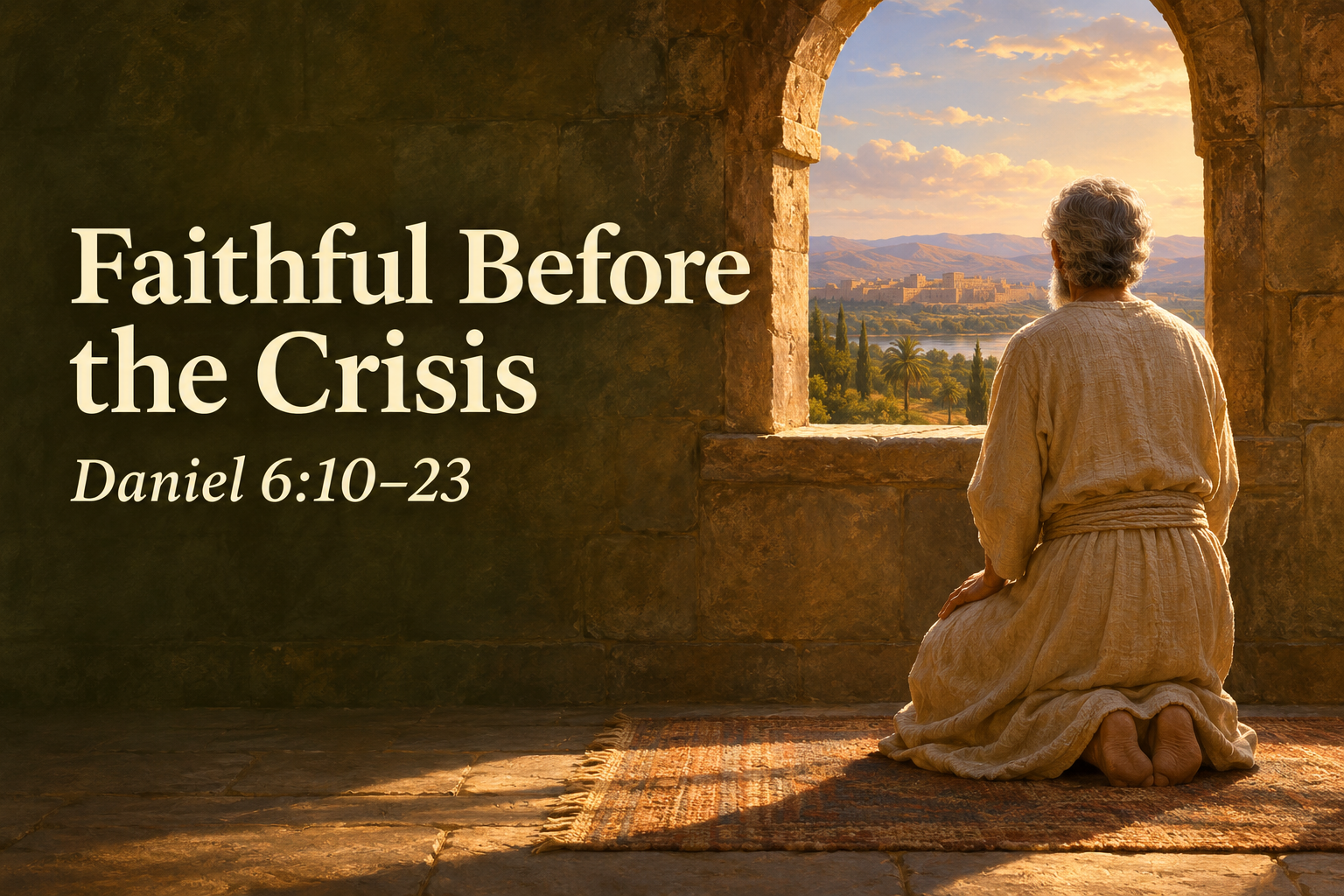
We often imagine courage as something we will discover when the difficult moment arrives. If the pressure becomes serious enough, perhaps we will suddenly become truthful, prayerful, and steady. Daniel 6 points us toward a quieter beginning: the habits we practice before anyone is watching.
When a royal decree makes Daniel’s prayers dangerous, he continues the pattern already established in his life. Scripture describes him praying and giving thanks “as he did before” (Daniel 6:10, WEB). Those few words invite us to consider what our ordinary days are preparing us to do.
Read Daniel 6:10–23 within the full chapter. Today’s quotations use the World English Bible (WEB).
Notice the integrity before the danger
The chapter introduces Daniel as a trusted official. His rivals search his work for grounds to accuse him, but they cannot find corruption or negligence. They turn instead to his allegiance to God, persuading the king to sign a decree that will make his prayer unlawful.
The story connects public responsibility with private devotion. Daniel’s faith is not an excuse for careless work. His dependable conduct is precisely what frustrates those looking for a legitimate complaint.
That connection deserves attention before we hurry to the lions. Faithfulness may begin with an accurate record, a promise kept, or a task completed responsibly when cutting a corner would be easier. These actions rarely look dramatic. They give honesty a place in the ordinary structure of a life.
This does not mean that a good reputation will prevent false accusations. Daniel’s integrity does not protect him from a deliberate trap. The passage invites responsible conduct without promising that everyone will recognize or reward it.
Keep turning toward God
Daniel knows that the decree has been signed. He returns home, kneels, prays, and gives thanks. He does not invent a new display to provoke his opponents; the narrator emphasizes continuity with his earlier practice.
We need not reproduce every detail of his setting to learn from that continuity. The direction of his windows and his daily pattern belong to this particular story. The lesson is not that God accepts only one posture, location, or number of prayers. Daniel’s enduring allegiance matters more than copying the arrangement of his room.
A modest, repeatable practice can help us turn toward God before an emergency. Attach a few minutes of prayer to a part of the day that already happens: the first quiet moment after waking, a lunch break, or the evening’s close. Read a short passage carefully and name a particular responsibility before God.
If you miss the practice, begin again without making shame the center of it. A habit serves attention and dependence; it should not become a way to rank yourself above others. Daniel’s example invites steadiness, not a performance of spiritual toughness.
Gratitude also belongs in his prayer while danger remains real. Giving thanks need not deny fear or call injustice good. It can acknowledge God’s faithfulness while asking honestly for help.
Distinguish faithfulness from recklessness
Daniel is discovered praying, accused, and placed in the den. The king’s concern cannot undo the decree. God preserves Daniel, and he is brought out unharmed because he trusted in God.
This is a testimony to God’s rescue in Daniel’s particular situation. It is not a guarantee that faithful people will always escape injury. Hebrews 11:32–40 remembers both remarkable deliverances and people who suffered without being released. Both groups are described in connection with faith.
We should therefore resist treating every disagreement as a lions’ den or every unwelcome request as persecution. Sometimes a correction is justified. Sometimes a conflict calls for listening, a clearer explanation, or an apology. Courage includes the willingness to examine our own conduct.
When a demand really conflicts with obedience to God, seek wise counsel and understand what is being asked. Use appropriate channels for help or protection. The story does not require us to seek danger, refuse lawful assistance, or remain in an unsafe situation merely to prove that we trust God.
The chapter’s later account of punishment is also sobering. The violence of the royal court is not an instruction for Christians to retaliate against opponents. Daniel’s faithfulness gives us no permission to wish destruction on people who challenge us.
Practice one dependable response
For Christians, courage is finally directed toward Jesus. Hebrews 12:1–3 calls us to perseverance by considering the One who endured the cross and now sits at God’s right hand. His faithfulness grounds our hope more deeply than confidence in our own resolve.
We may feel afraid and still take a truthful step. We may need encouragement and still keep a promise. Dependence on Christ leaves room for help from other people rather than requiring us to manage every pressure alone.
Choose one responsibility that is already yours. Perhaps you need to correct an inaccurate statement, finish work you have neglected, or answer a question without hiding an inconvenient fact. Keep the action small enough to complete and clear enough to evaluate.
Then place a simple prayer practice beside it. Ask God for wisdom, carry out the responsibility, and return to prayer afterward. Over time, such practices can give faith a dependable place in the day. They do not purchase safety or make us invulnerable; they help us live attentively before God.
Today’s practice: identify one ordinary responsibility and complete it with particular care. Set aside a brief moment to pray about it before beginning, offering that prayer in Jesus’ name.
For reflection:
- What do my ordinary habits prepare me to do under pressure?
- Where might greater care or honesty be needed in my responsibilities?
- Who could offer wise support if a difficult decision comes?
A prayer for steady faithfulness
Father, help us serve You in ordinary responsibilities and difficult decisions. Give us honest hearts, careful judgment, and the humility to seek help. When we are afraid, direct our trust toward Christ and teach us to persevere without seeking conflict. We offer this prayer in Jesus’ name. Amen.