It can be hardest to receive help in something we already do well. A beginner expects to learn, but experience can make a question feel like a challenge to our competence. We may defend an explanation before we have considered whether it needs improving.
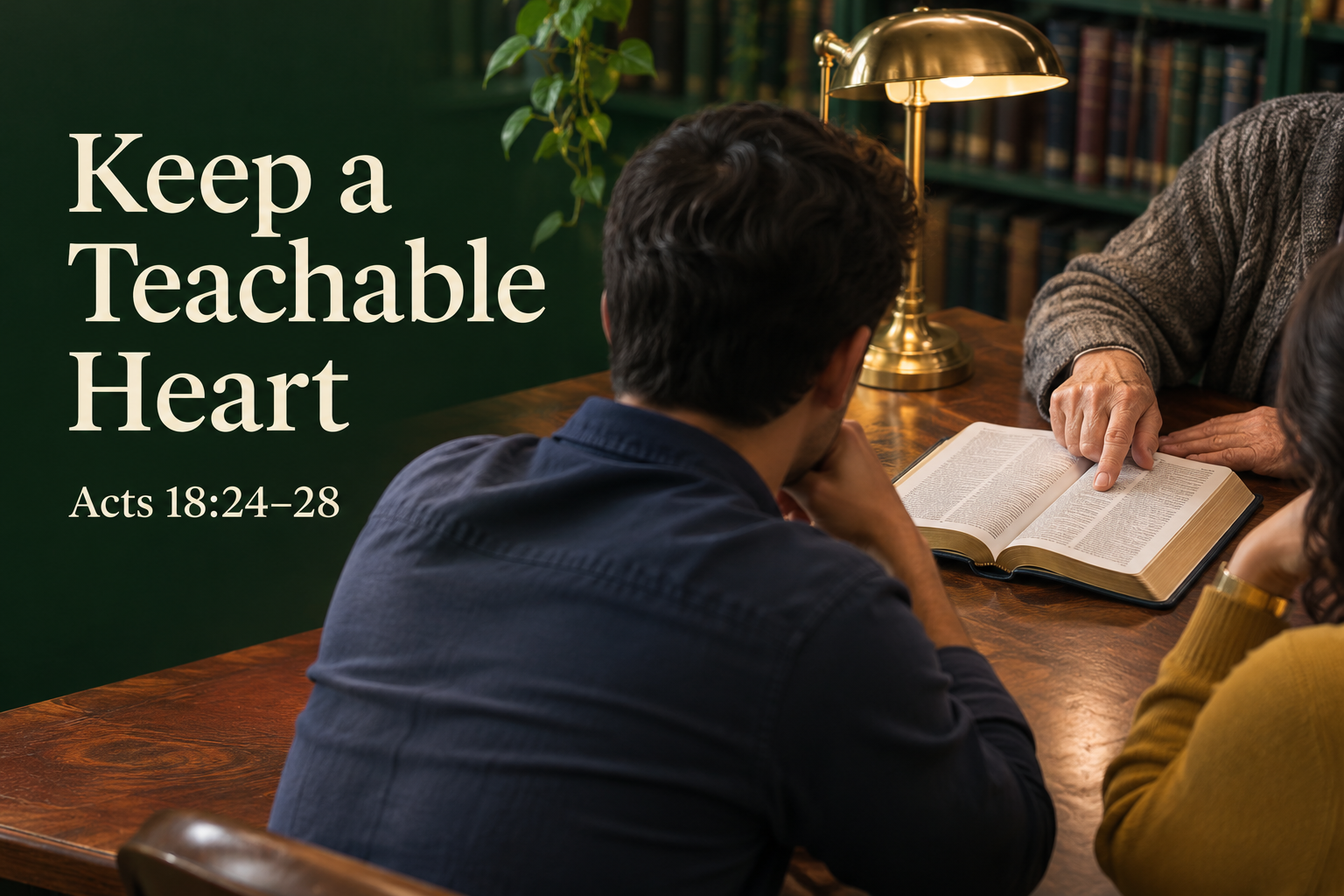
Acts 18:24–28 introduces a capable teacher who still has room to grow. Apollos knows Scripture, speaks boldly, and teaches about Jesus. Priscilla and Aquila hear him, recognize something incomplete, and help him understand more accurately. His story invites us to bring both our gifts and our need for instruction into the life of faith.
Read Acts 18:24–28 within the full chapter. Today’s brief quotations use the World English Bible (WEB).
Honor what is good without calling it complete
Luke describes Apollos generously. He is eloquent, strong in the Scriptures, and fervent in spirit. He teaches accurately about Jesus, although his knowledge of baptism extends only to John’s baptism.
The account holds real ability and incomplete understanding together. It does not require us to dismiss everything Apollos knows because he needs further instruction. Neither does it treat enthusiasm or eloquence as proof that his understanding is complete.
That distinction can help us listen more fairly. A person may offer valuable insight and still need correction. Someone we respect may have overlooked a relevant passage. We ourselves may have explained something confidently that deserves another careful reading.
Recognizing a limit need not erase a gift. In fact, honoring a person’s ability can include taking their growth seriously enough to offer help. Encouragement becomes more useful when it has room for truth.
We should also resist filling the story’s silences with imagined details. Luke names the limitation in Apollos’s understanding, but does not give us a transcript of the conversation that follows. We can learn from what is recorded without pretending to know every question they discussed or every step they took.
Offer instruction with care and substance
Priscilla and Aquila take Apollos aside. Luke says they “explained to him the way of God more accurately” (Acts 18:26, WEB). Their help has a clear purpose: a more accurate understanding of God’s way.
Taking him aside gives the conversation a different setting from a public contest. We should not make that detail an absolute rule that every correction must always happen privately; some public errors require an appropriate public response. Here, however, it shows a way of helping that does not make humiliation the point.
Before correcting someone, clarify what you believe needs attention. Can you identify the statement fairly? What does the relevant Scripture say in context? Are you offering a reason the other person can examine, or merely expecting them to accept your confidence?
Ask questions that leave room to discover whether you have understood. An opening such as asking how a person reads a particular passage can begin a genuine conversation. It should not be a trap with a verdict already concealed inside it.
Kindness does not replace substance. Priscilla and Aquila do more than reassure Apollos that sincerity is enough. Their explanation concerns truth. Respectful instruction serves another person by helping them see something more clearly.
Receive help without surrendering discernment
Apollos’s story continues with encouragement from the believers and useful service elsewhere. We do not hear him give a speech about being corrected; we see the account move forward toward his helping others.
Proverbs 9:8–9 also connects wisdom with willingness to receive instruction. Of the righteous person who is taught, it says, “he will increase in learning” (Proverbs 9:9, WEB). Wisdom does not mean reaching a point at which no one can teach us.
A teachable response can begin with a pause. Instead of immediately explaining why the other person must be mistaken, ask for the passage, example, or reasoning behind their concern. Restate what you have heard before answering. You may discover a genuine gap, a misunderstanding, or a question that needs further study.
Teachability does not require accepting every claim or obeying a forceful personality. A correction should be examined. We can ask for time, consult Scripture, and seek help from trustworthy people. Respect and careful judgment belong in the same conversation.
If you discover an error in something you have shared, correct it where appropriate. A simple acknowledgment can be enough. Avoid making the correction into a performance of shame or expecting those affected to reassure you. Let the clearer understanding guide what you say next.
Let learning serve the message about Jesus
At the end of the passage, Apollos helps believers and shows from the Scriptures that Jesus is the Christ. The purpose of his learning reaches beyond protecting his reputation. His gifts serve the truth about Jesus and the people who need that truth.
This gives Christian learning a direction. We study not merely to win an argument, collect impressive information, or become indispensable. We want to understand faithfully so that our words and actions can point more clearly toward Christ.
There may be a particular area where you have stopped asking questions because others expect you to know the answers. Bring that area honestly into prayer and study. Teaching, leading, parenting, and long experience do not remove our need to keep learning.
Today’s practice: choose one biblical question you have been answering mostly from habit. Read its surrounding passage carefully. Ask a trustworthy fellow Christian to discuss it with you, and make room to hear a perspective you may have missed. Keep the conversation focused on understanding rather than scoring a point.
For reflection:
- Where does receiving instruction feel like a threat to my competence?
- How could I make a necessary correction more truthful and respectful?
- What could deeper understanding help me offer to others?
A prayer for a teachable heart
Father, thank You for the people who help us understand Your word. Give us humility to receive instruction, patience to examine it carefully, and courage to correct our mistakes. Shape our learning so that it serves others and points toward Jesus. We offer this prayer in Jesus’ name. Amen.